
FAQ: Law Enforcement Approval. A Guide to Reading The Plea Offer

Every so often, a law enforcement officer sends me a picture of a plea offer and asks me what, exactly, the prosecutor is asking them to approve. The charge usually is not the confusing part. The officer knows the charge, knows the investigation, and probably knows considerably more about where the defendant was standing at 2:17 a.m. six months ago than I ever will.
"Has law enforcement approved the plea agreement?" It is also important because during almost any felony plea, the Judge asks the prosecutor whether or not law enforcement has approved of the plea agreement. The Judge wants to know if law enforcement has a particular opinion, in favor or against, a certain plea agreement and why. Those are important details a Judge may not overlook. That is why prosecutors will send law enforcement a picture of their proposed plea offer and ask for approval or input. It is also simply a sign of respect from prosecutor to officer.
The confusion starts when the prosecutor sends over something that says 12/5/3, F&C, restitution, no HOB and apparently assumes that a row of numbers and four random letters adequately explains the proposed resolution of a felony case.
To criminal lawyers, it does. That is the problem.
Prosecutors and defense attorneys use this shorthand so often that we forget it looks completely ridiculous to everyone else. We can reduce twelve years of sentencing exposure, prison time, suspended time, probation, financial obligations, and a habitual offender agreement to half a line on a legal pad and then send a picture of it to an officer with, “You good with this?” That may be efficient. It is not particularly communicative.
So, before you text back “looks good” because the first number is large and therefore feels appropriately serious, let me translate what you are actually looking at.
12/5/3
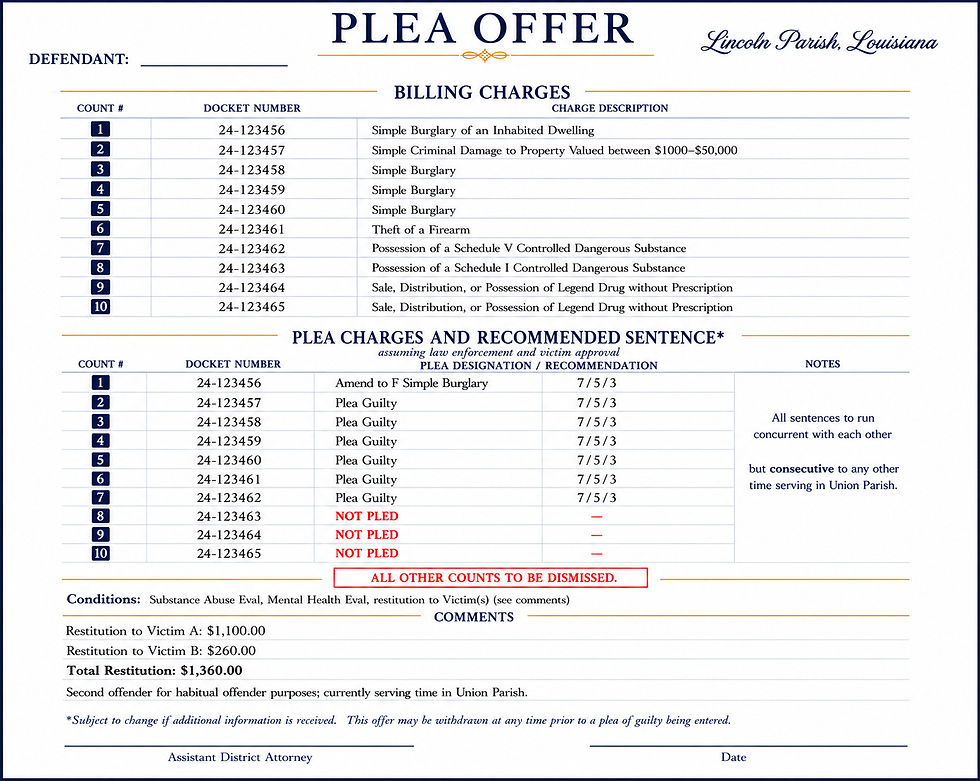
Around here, we commonly use numbers separated by slashes to describe a split sentence. The first number is the total sentence imposed. The second number is the amount of time the defendant is ordered to serve. The third number is the period of supervised probation.
So, 12/5/3 means the defendant receives twelve years at hard labor, serves five years, has the remaining seven years suspended, and is placed on three years of supervised probation.
The defendant is not serving twelve years under that offer. Five years are ordered to be served. Seven years are suspended. Three years of supervised probation follow.
I do not know who first decided that twelve years, five to serve, seven suspended, and three years of probation could reasonably be communicated by writing 12/5/3 and offering no further explanation. I assume it was a lawyer in a hurry, which narrows the field to almost all of us.
The seven suspended years are what you may hear lawyers describe as time “hanging over his head.” They have not disappeared. They are suspended, and if probation is later revoked, that suspended time may suddenly become a considerably more important part of the defendant’s life.
That distinction is usually why the officer sent me the plea sheet in the first place. The prosecutor says “twelve years,” the officer sees twelve years, but the proposed sentence may actually require five years to be served. Those are not the same thing, and approving one because you thought you were approving the other is a fairly poor time to discover that criminal lawyers have their own numerical dialect.
Concurrent and Consecutive
Concurrent and consecutive only matter when there is more than one sentence involved.
There has to be something for the sentence to run with or after. Writing “12/5/3 concurrent” by itself tells you very little because the obvious next question is: concurrent to what?
Assume the defendant is pleading to two counts and receives five years on Count One and five years on Count Two. If the sentences are concurrent, they run at the same time. The defendant does not serve five years, finish that sentence, and then begin another five years.
The two sentences run together.
If those same five-year sentences are consecutive, one runs after the other. The defendant serves one sentence and then the next. Five plus five is now ten, and for one brief shining moment the math works exactly the way everyone learned it in elementary school.
The problem is that actual plea offers are rarely kind enough to stay that simple. A defendant may have two docket numbers. The prosecutor may offer five years on one case concurrent with five years on another case. The defendant may already be serving a sentence, and the new jail time may be offered consecutive to that existing sentence. There may be multiple counts with some sentences concurrent and another sentence consecutive.
For example, an offer might provide for five years to serve on Case A, five years to serve on Case B concurrent with Case A, and two years on Case C consecutive to those sentences. That does not equal twelve years to serve. The five-year sentences run together, and the two-year sentence runs afterward, for a total of seven years to serve before considering jail credit or DOC calculations.
This is why you cannot see the word concurrent somewhere on the page and assume everything runs together. You have to ask what sentence is concurrent with what other sentence. The same is true of consecutive. In criminal sentencing, apparently even prepositions need their own factual investigation.
Fines and Costs
You may see F&C, which means fines and costs. This is generally exactly what it sounds like: in addition to imprisonment or probation, the defendant may be responsible for an imposed fine and court costs.
Sometimes the specific amount is written into the plea offer. Sometimes the offer simply says “fines and costs,” and the amount is addressed later. It is part of the proposed resolution even though it usually gets approximately four seconds of attention while everyone argues about prison time.
Court costs are patient. They are comfortable being ignored temporarily.
Restitution
Restitution is different from a fine. A fine is a financial penalty. Restitution generally concerns an identifiable loss associated with the offense.
For law enforcement, this is one term worth stopping on before approving an offer. Was property damaged? Was something stolen and never recovered? Is there an actual documented loss? Does the prosecutor know the amount?
Writing “restitution” on a plea sheet does not cause a restitution figure to descend from the ceiling of the courtroom. Somebody eventually has to establish the loss. If the victim has invoices, repair estimates, receipts, or other documentation, this is a wonderful time for that information to make its way into the file and not three minutes before the judge takes the plea.
The legal system is deeply committed to the phrase “we will deal with that later.” Later is where paperwork goes to become someone else’s emergency.
No HOB
HOB means habitual offender bill. You may see no HOB, without HOB, or some variation of the same shorthand. It means the State is agreeing not to pursue a habitual offender enhancement as part of the plea agreement.
Depending on the defendant’s criminal history, that may be a significant part of the offer. This is one reason an officer should not look only at the number of years. Two plea offers can contain the same sentence and still represent very different agreements depending on what the State is giving up as part of the deal.
If you know the defendant and your immediate reaction is, “How is this man not habitual? I have arrested him enough times to recognize his mother’s driveway,” remember that arrests and qualifying prior felony convictions are not interchangeable. Habitual offender law has its own requirements. Knowing somebody’s booking photograph by memory is not, standing alone, a sentencing enhancement.
Credit for Time Served
You may also see credit for time served. This means qualifying time the defendant has already spent in actual custody is credited toward the sentence.
So, if the plea offer calls for five years to serve, that does not necessarily mean a completely new five-year clock begins on the day of the plea. If the defendant has already spent qualifying time in custody on the case, that time matters.
This is usually the point in the conversation where someone asks the most reasonable question imaginable: “Fine. So when is he actually getting out?”
Unfortunately, that is also where the easy part ends.
So When Is He Actually Getting Out?
If someone tells me, “He got twelve years. When is he getting out?” my first question is probably going to be whether he actually received twelve years to serve or whether he received something like 12/5/3. Those are very different sentences.
If the answer is 12/5/3, then five years are ordered to be served, seven years are suspended, and three years of supervised probation follow. After that, I need to know the offense, the date of the offense, whether any portion of the sentence is without benefit, how much credit for time served applies, and what Department of Corrections rules govern the sentence.
I realize you asked one question and I responded with five. This is not personal. This is simply what happens when you ask a lawyer a question that contains the word “actually.”
The offense date matters because Louisiana’s good-time and sentence-computation laws have changed over time. Two defendants can receive sentences that look similar on paper and still have different release calculations because different laws apply.
That is why, when an officer asks me how much time somebody will actually do and I immediately ask for the offense date, I am not deliberately being difficult. At least not in that particular moment. I am trying not to give a confident answer that turns out to be wrong once DOC applies the law governing the sentence.
The plea sheet tells you the sentence being proposed. It does not always tell you the exact date the defendant will physically walk out of a correctional facility. Credit for time served, good-time eligibility, offense dates, sentencing restrictions, and DOC calculations can all matter.
This is also why I am generally unwilling to calculate a precise DOC release date from a blurry photograph of a plea sheet taken at an angle that suggests the sender was hiding the phone under counsel table.
Putting It All Together
Suppose the prosecutor sends an officer an offer that reads 12/5/3, F&C, restitution, no HOB.
The prosecutor is asking the officer to consider an agreement under which the defendant receives a twelve-year sentence at hard labor, with five years ordered to be served, seven years suspended, and three years of supervised probation. The defendant may also owe fines and court costs and be required to pay restitution. As part of the agreement, the State is agreeing not to pursue a habitual offender bill. The five years to serve remain subject to applicable credit for time served and Department of Corrections sentence calculations.
That is the offer.
The prosecutor is not simply asking, “Are you okay with twelve years?” The real question is whether you are comfortable with five years being ordered to be served, seven years being suspended, three years of supervised probation, the listed financial obligations, and the State resolving the case without pursuing a habitual offender enhancement.
That is a considerably more complicated question than the line on the plea sheet suggests.
Criminal attorneys shorten the whole thing to 12/5/3, F&C, restitution, no HOB because we use the language every day. Then we send it to an officer who does not negotiate pleas every day and act mildly surprised when the phone rings.
So, to every officer who has ever sent me a picture of a plea offer and asked, “Can you tell me what this actually means?” The question is fair and yes, I usually can.
We wrote an entire sentencing agreement like a football play and then forgot not everyone was in the huddle.
Hopefully, now you have the decoder ring.
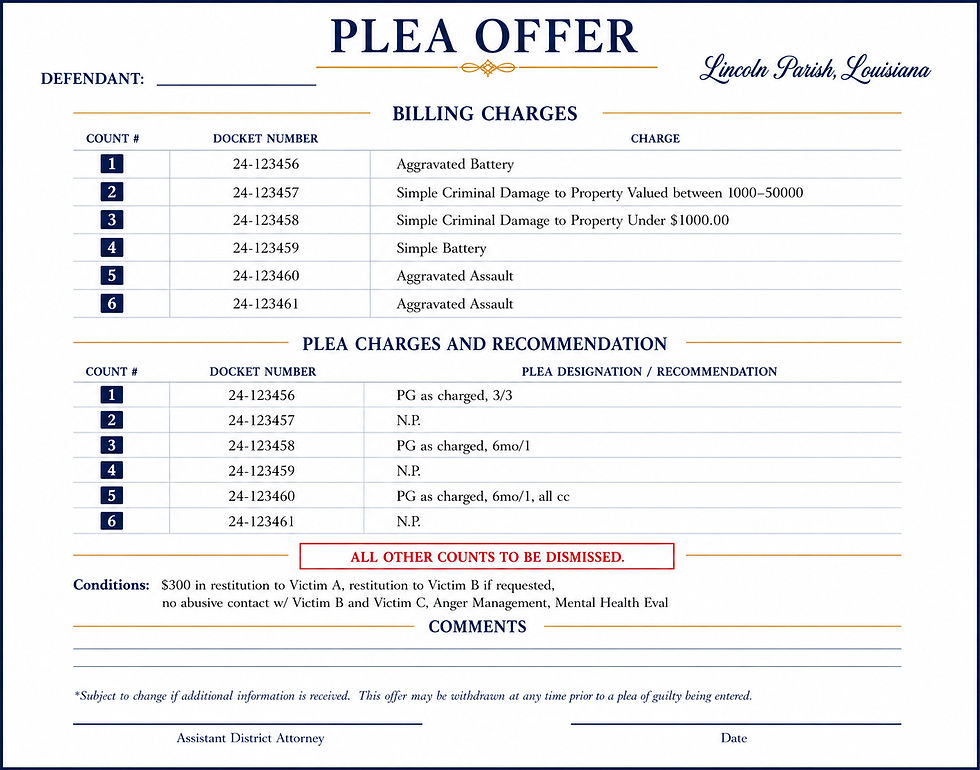
See real life (edited for legal and privacy purposes) plea offer samples and a plain English explanation of each, below.
Judith L. Hampton
Attorney-at-Law
Hampton Law Firm
Local Roots & Trusted Service for the Northeast Louisiana Area.
Areas of Practice Include:
📌Successions
📌Estate Planning
📌Real Estate & Title Insurance
📌Criminal Defense
📌Uncontested Divorce
📌Boundary Disputes
📌Interdiction & Guardianship
📌 Other Civil Matters
🗓️Schedule Your Appointment With Attorney Judith L. Hampton below:
📃Prefer to skip the appointment? Send us your information via our secure intake form using the button below:
🛍️Need a simple legal document without the attorney fees? Shop our self-help legal templates drafted by Judith L. Hampton, Licensed Louisiana Attorney by clicking the link below:
🔔Would you benefit from ongoing access to attorney guidance and legal advice for less than the cost of a consultation fee? Check out our subscription plans using the link below. All subscribers gain free access to our entire document library, receive monthly attorney guidance and 25% off of all full representation services.
Come see us at:
📍 203 North Main Street
Farmerville, Louisiana 71231
Contact us at:
📱 Call or Text 318-368-7444
💬 For a quick-start, text "HELP" to 318-368-7444
🛜 Chat with our front desk using our App – Join our mobile community by downloading the “Spaces by Wix” App for free from your App store, search “Hampton Law Firm” and use Invite Code VCZQIA to join!




Comments