

Series: Before You Publish: When Third Party Grudge Holders Use Defamatory Social Media Posts To File Official Legal Documents...Let's Check Out The Consequences.
- Hampton Law Firm ⚖️

- May 17
- 11 min read
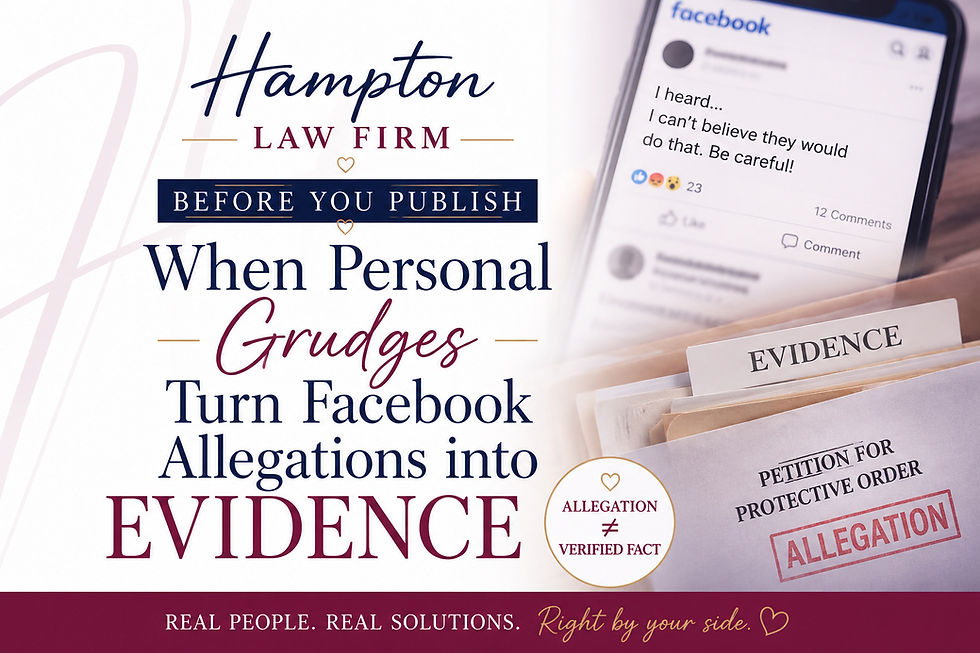
Some Grudges Cost You More Than Time, Effort, Energy...Some Cost You Legal Liability Too
Disclaimer: This article is for general educational and commentary purposes only. It is not legal advice and does not create an attorney-client relationship. Defamation, sanctions, privilege, malicious prosecution, abuse of process, false-report issues, and damages are highly fact-specific and should be evaluated by licensed counsel based on the exact words used, the evidence available, the forum of publication, and the applicable law.
There is a dangerous difference between an allegation and proof. In a courtroom, that difference is protected by rules, burdens of proof, sworn testimony, admissible evidence, cross-examination, judicial review, and consequences for filings made without reasonable inquiry. On social media, that difference is too often erased by speed, outrage, anonymous sourcing, careless wording, and the assumption that if a claim is dramatic enough to attract attention, it must be true enough to publish. That is not journalism. That is not due diligence. And when false information travels from a Facebook post into the hands of someone with a grudge, an ex-spouse, a former friend, a business rival, or any third party who then uses it as “proof” in a civil court proceeding, the damage becomes far more than gossip.
The American judicial system is built around proof standards because the law recognizes that being accused is not the same thing as being guilty. In ordinary civil cases, a party generally must prove a claim by a preponderance of the evidence, meaning the factfinder is persuaded that the claim is more likely true than not true. In matters requiring a higher degree of confidence, courts may require clear and convincing evidence, which is more rigorous and requires the contention to be highly probable. In criminal cases, because liberty and stigma are at stake, due process requires proof beyond a reasonable doubt before a person may be convicted. Those standards exist because words alone, suspicion alone, and repetition alone are not evidence.
Setting | Common Standard | What It Requires | Why It Matters |
Civil lawsuit | Preponderance of the evidence | More likely true than not | Prevents bare accusations from becoming judgments without evidence. |
Certain heightened civil matters | Clear and convincing evidence | Highly probable truth | Recognizes that some civil consequences require stronger proof. |
Criminal prosecution | Beyond a reasonable doubt | Constitutionally high confidence in guilt | Protects liberty, reputation, and due process before punishment. |
Ethical journalism | Verification, context, source evaluation, and meaningful response opportunity | Responsible confidence before publication | Protects the public from misinformation and protects individuals from reputational harm. |
Journalists are not judges, and a newsroom is not a courtroom. But that does not mean journalists have no standards. Professional journalism has long recognized that publication carries consequences, and consequences require discipline. The Society of Professional Journalists instructs journalists to “take responsibility for the accuracy of their work,” “verify information before releasing it,” use original sources when possible, provide context, identify sources clearly, consider motives before granting anonymity, and diligently seek the subject of coverage for a response to allegations of wrongdoing. The Radio Television Digital News Association similarly emphasizes verification, context, transparency, and acknowledging what is unknown. In plain language, if you are going to publicly accuse someone of wrongdoing, you need more than a screenshot, a rumor, or a source who wants revenge.
That distinction matters because journalistic proof is not legal proof, but it is still a standard of professional responsibility. A reporter may not have subpoena power, courtroom evidence, or a judge’s authority, but a reporter controls whether to publish, how to frame the story, what words to use, whether to contact primary sources, whether to disclose uncertainty, whether to identify source limitations, and whether to give the accused person a meaningful opportunity to respond. Ethical journalism does not require waiting for a final court judgment before reporting on every public matter. It does, however, require refusing to convert rumor into fact simply because the rumor is clickable, convenient, or useful to someone else’s personal agenda.
The most legally dangerous reporting often happens through word choice. A publisher may believe they are avoiding liability by using phrases such as “allegedly,” “reportedly,” “has yet to be charged,” “according to sources,” or “in my opinion.” But the law looks beyond magic words. In Milkovich v. Lorain Journal Co., the United States Supreme Court rejected the idea that there is a broad constitutional privilege for anything labeled “opinion” when the statement implies a provably false fact. In other words, saying “I believe she committed a crime” may still communicate to readers that the publisher knows facts proving criminal conduct. If that factual implication is false, the label “opinion” may not save it.
This is especially important when a post uses terms that carry legal meaning or criminal connotation. Words such as “brandished,” “victim,” “crime,” “cover-up,” “corruption,” “children were present,” “law enforcement confirmed,” “judge’s daughter,” “detective husband,” “public defender,” or “has yet to be charged” do more than tell a story. They suggest a factual framework. They may imply that a crime occurred, that authorities are refusing to act, that children were endangered, that a public official intervened, or that someone received special treatment because of family or professional connections. If the facts do not support those implications, the problem is not merely poor writing. It may become defamation by implication, reputational injury, or evidence of reckless disregard for truth.
Under Louisiana law, defamation generally requires defamatory words, publication, falsity, fault, and resulting injury; Louisiana courts have recognized these core elements in cases such as Costello v. Hardy. In American constitutional defamation law, the level of fault can depend on whether the plaintiff is a public official, public figure, limited-purpose public figure, or private person, and whether the speech involves a matter of public concern.
But even where First Amendment protections are strong, they are not a license to invent facts, ignore obvious contradictions, or imply criminal conduct without support. The law protects robust debate. It does not protect every false factual implication merely because it was typed into a Facebook post.
The Supreme Court’s decision in Harte-Hanks Communications, Inc. v. Connaughton is especially important for modern social media publishers because it explains the difference between simple negligence and evidence of actual malice. Falling below professional reporting standards alone may not automatically prove actual malice in a public-figure case. But the Court also recognized that reckless disregard can be shown when a publisher has serious reasons to doubt a claim, avoids obvious sources, ignores contrary evidence, or publishes accusations despite information undermining the story. That principle should matter deeply to anyone who claims to be a reporter, advocate, commentator, or community watchdog.
The legal risk increases when an unverified post does not remain merely a post. A defamatory statement can become more damaging when it is transferred to third parties who treat it as factual support for legal action. A person may read a Facebook accusation, believe it, repeat it to an agency, attach it to a complaint, cite it in a custody dispute, include it in a protective-order filing, submit it to a licensing board, or use it as the foundation for public allegations in court. At that point, the false statement moves from gossip to paperwork, and from paperwork to public record. The reputational harm can multiply because the accusation now appears to have institutional weight, even if the only original source was an unverified social media post.
This is where people need to understand the difference between evidence and amplification. If an ex-spouse, former friend, disgruntled family member, professional rival, or person holding a grudge takes a defamatory Facebook post and files a civil proceeding based on it, that person has not magically turned gossip into proof. They may have simply republished the allegation in a more damaging forum. They may have increased the audience. They may have increased the harm. And if they knew the allegation was false, had reason to know it was unverified, or deliberately avoided checking obvious facts because the accusation served their purpose, they may have created additional exposure for themselves.
Louisiana procedure recognizes that legal filings are not supposed to be rumor containers. Louisiana Code of Civil Procedure article 863 requires pleadings to be signed and provides that the signature certifies, after reasonable inquiry, that the filing is well grounded in fact, warranted by existing law or a good-faith legal argument, and not filed for an improper purpose. That rule matters in the Facebook-to-courthouse pipeline. If someone files legal papers based only on an inflammatory post, without checking records, contacting reliable witnesses, reviewing available evidence, or evaluating whether the accusation is true, the issue is no longer just bad judgment. Depending on the facts, it may raise questions of sanctions, improper purpose, credibility, malice, and recoverable damages.
There are also circumstances where knowingly false statements in official settings can create serious legal consequences beyond ordinary defamation. Louisiana law criminalizes filing or depositing false public records when a person knowingly files or maintains a document containing a false statement or false representation of a material fact in a public office or with a public official. Louisiana law also defines criminal mischief to include giving a false report or complaint to a law-enforcement officer about the commission or attempted commission of a crime. And when a false statement is intentionally made under oath or equivalent affirmation for use in a judicial proceeding or other authorized proceeding, Louisiana’s perjury statute may apply if the statement is material and the required elements are met. These are not labels to throw around carelessly, but they are reminders that the legal system takes false official accusations seriously.
Malicious prosecution and abuse-of-process theories are also part of this conversation, although they are fact-specific and should not be overstated. In Jones v. Soileau, the Louisiana Supreme Court identified the elements of malicious prosecution as the commencement or continuance of an original criminal or civil judicial proceeding, legal causation by the defendant, favorable termination for the plaintiff, absence of probable cause, malice, and legally cognizable damage. That is a demanding standard, but it exists for a reason. The courts recognize that legal proceedings can be misused as weapons. When someone knowingly drags another person into litigation based on unverified or false social media claims, especially for revenge, leverage, humiliation, custody advantage, business pressure, or public embarrassment, the conduct may become more than ugly. It may become legally significant.
This does not mean every statement made in a court filing automatically creates a separate defamation claim. Many jurisdictions recognize litigation privileges that may protect statements made in judicial proceedings when they are relevant to the matter at issue. But privilege is not the same thing as truth, and privilege is not the same thing as ethics. A litigation privilege may affect whether a defamation claim can be brought for a statement inside a proceeding, but it does not morally justify using known falsehoods, does not necessarily protect separate publication outside the proceeding, and does not eliminate duties imposed by procedural rules, court sanctions law, criminal statutes, or professional responsibility rules. The courtroom is not a laundering machine for internet rumors.
The most troubling scenario is one in which a person knows an allegation is unverified or false, but repeats it anyway because the allegation is useful. That is where careless reporting begins to look like a strategy, and where a private grudge begins to look like a campaign. A false post can be used to create pressure. A third party can cite the post to manufacture concern. Public filings can then be used to make the original rumor appear more legitimate. The cycle becomes circular: “It must be serious because it is in court,” even though it may be in court only because someone relied on the original false post. That circular logic is exactly why due diligence matters at every stage.
Professional journalists should understand that an unnamed source is not a substitute for evidence. Anonymous sources may sometimes be necessary, but SPJ and RTDNA both caution that anonymity deprives the audience of information needed to evaluate reliability and motive. When the source has a personal conflict, legal dispute, custody interest, political motive, business rivalry, revenge motive, or desire to harm the subject, those motives are not side issues. They are central to credibility. A journalist who hides source weakness from the audience while presenting the allegation as fact is not merely failing to cite sources. The journalist is distorting the reliability of the story.
Likewise, giving the accused person a token opportunity to respond is not the same thing as meaningful due diligence. A brief message sent shortly before publication, without providing the substance of the allegations, the supposed evidence, the deadline, or the intended framing, does not satisfy the spirit of ethical reporting. SPJ specifically states that journalists should diligently seek subjects of coverage to allow them to respond to criticism or allegations of wrongdoing. That standard recognizes a basic truth: if a publisher is about to accuse someone of misconduct, especially criminal or professional misconduct, fairness requires more than a performative “no comment” trap.
Risk Area | How False Information Causes Harm | Why Due Diligence Matters |
Defamation | False factual statements or implications damage reputation. | Verification reduces false claims and supports responsible reporting. |
Defamation by implication | True fragments are arranged to imply a false conclusion. | Context prevents misleading readers through selective wording. |
Court sanctions | A party files allegations without reasonable inquiry or for improper purpose. | Louisiana filings must be factually grounded and legally warranted. |
False official reporting | A person gives false criminal information to law enforcement or files false material statements in public records. | Official processes are not tools for revenge or rumor laundering. |
Malicious prosecution | A proceeding is allegedly initiated without probable cause, with malice, and ends favorably to the accused party. | Courts recognize that litigation itself can become a wrongful weapon. |
Damages expansion | Online accusations become agency records, court records, custody allegations, or searchable public accusations. | Repetition and permanence increase reputational, emotional, professional, and financial harm. |
The difference between court standards and journalism standards can be summarized this way: courts impose legal consequences after evidence; ethical journalists impose public consequences only after verification. When either system reverses that order, people get hurt. A court that punishes without proof violates due process.
A publisher who destroys a reputation without verification violates professional ethics and may cross into legal liability.
A third party who imports a false post into legal proceedings without reasonable inquiry risks compounding the harm and giving falsehood the appearance of official legitimacy.
The better standard is not silence. The better standard is responsibility. Real wrongdoing should be investigated. Public officials should be scrutinized. Courts, law enforcement, lawyers, and public agencies should be held accountable when evidence supports accountability. But public interest reporting is not the same thing as public curiosity, and watchdog journalism is not the same thing as social media prosecution. A story becomes stronger, not weaker, when the journalist verifies documents, cites sources, explains what is unknown, contacts all sides, avoids loaded legal terms, corrects errors, and refuses to publish what cannot be supported.
My message to people who publish is simple: raise the standard before the law forces you to.
rces you to. Learn the legal difference between allegation and proof. Learn the ethical difference between reporting and inflaming. Learn why source motive matters, why children and private family matters require heightened care, why criminal implications require evidence, and why “viral” is not a substitute for “verified.” If you want to hold yourself out as a reporter, advocate, investigator, or trusted community voice, then accept the responsibilities that come with that role: accuracy, fairness, transparency, context, restraint, correction, and accountability.
My message to people who weaponize these posts is just as direct: stop using the legal system as a megaphone for personal bitterness. If you are taking an unverified Facebook post and using it to hurt someone in court, in custody litigation, in professional complaints, in business disputes, or in public records because you are angry, jealous, resentful, or looking for leverage, that conduct is not noble. It is destructive. It is reckless. And in the right facts, it can be legally costly. There are enough real problems in the world. Put something good into it. Build something. Help someone. Tell the truth. Do not tear other people down and then hide behind paperwork.
For those harmed by false posts and by third parties who repeat them in legal proceedings, the call to action is equally important: stand up, but stand up lawfully and strategically. Preserve screenshots, URLs, timestamps, comments, shares, messages, pleadings, exhibits, reports, and evidence of damages. Identify who originated the claim, who repeated it, who relied on it, and where it traveled. Demand corrections where appropriate. Consult counsel before responding impulsively. Use the law to expose falsehood, challenge unsupported filings, seek sanctions where justified, pursue remedies where available, and stop the cycle by which unverified online accusations become public allegations. The answer to reckless speech is not reckless retaliation. The answer is truth, evidence, accountability, and a legal system that still understands the difference between accusation and proof.
References
Drafted by Judith L. Hampton, Attorney at Law, Hampton Law Firm.
© Hampton Law Firm. For educational commentary only.



Comments